Dense Matchers for Dense Tracking
Jelínek, Šerých, Matas. Computer Vision Winter Workshop (CVWW), 2024.
MFT [1] tracks a point by chaining optical flow over logarithmically spaced baselines. Those long baselines are exactly the large-displacement, large-appearance-change regime that wide-baseline dense matchers are trained for, and RAFT [2] (MFT’s flow backbone) is not. Swapping in a dense matcher on the confident matches, and keeping RAFT elsewhere, lifts long-term tracking accuracy.
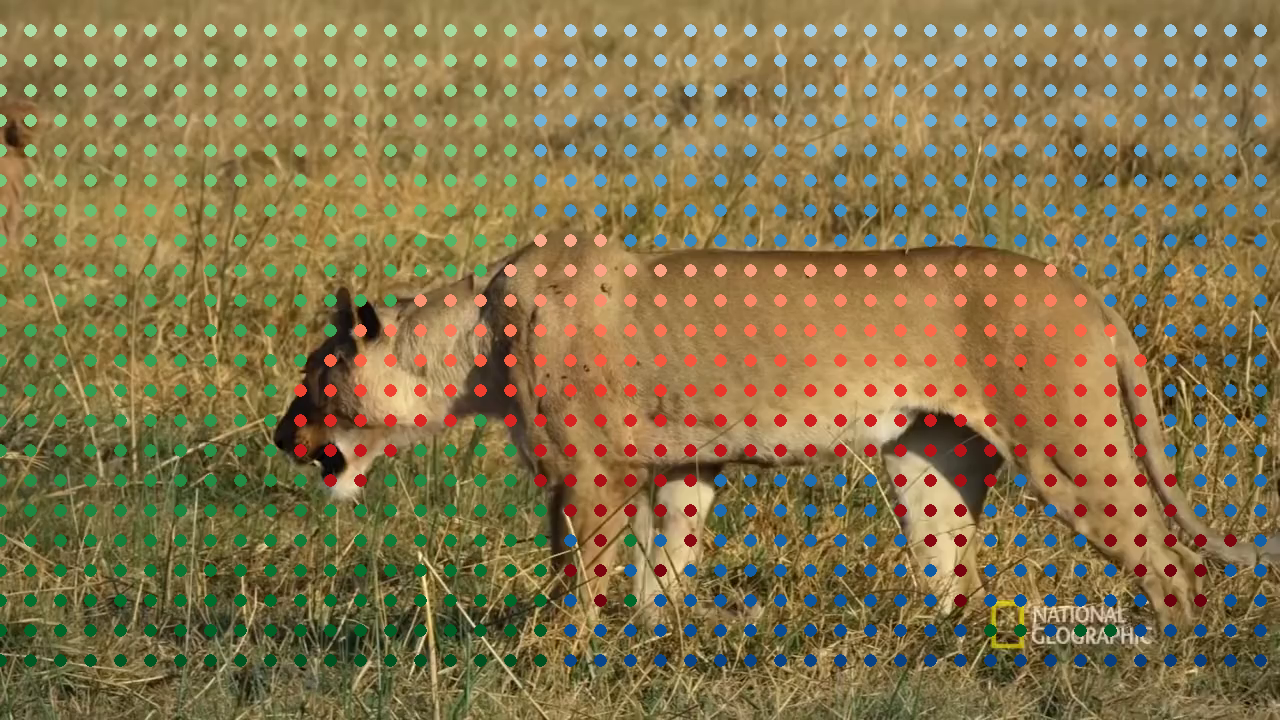
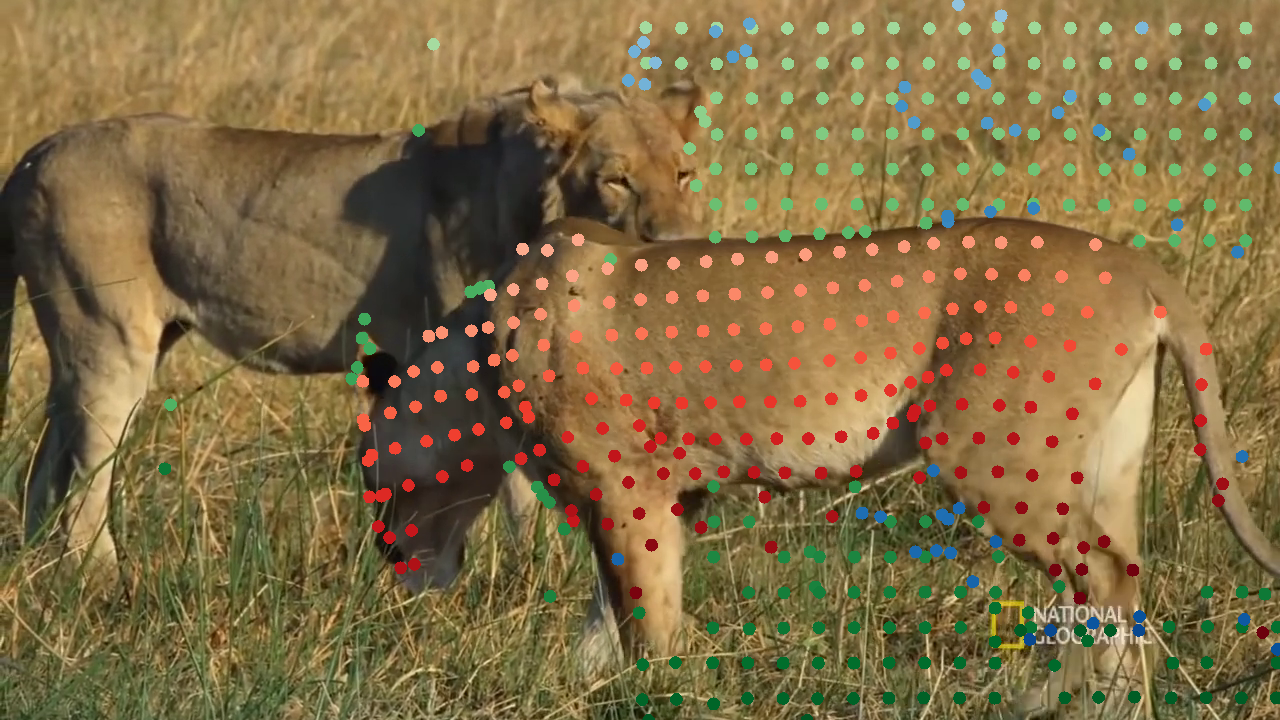
MFT builds a long-term flow by chaining through an intermediate frame \(i_M\). Writing \(\mathcal{F}^{(i,j)}\) for the flow from frame \(i\) to \(j\) and \(\mathbf{p}_i = \mathbf{p}_1 + \mathcal{F}_{\mathrm{MFT}}^{(1,i)}(\mathbf{p}_1)\) for the tracked position of a reference point \(\mathbf{p}_1\),
\[\mathcal{F}_{\mathrm{MFT}}^{(1,j)}(\mathbf{p}_1) = \mathcal{F}_{\mathrm{MFT}}^{(1,i_M)}(\mathbf{p}_1) + \mathcal{F}^{(i_M,j)}(\mathbf{p}_{i_M}),\]where \(i_M = j - \Delta_k\) (log-spaced \(\Delta_k = 2^{k-1}\)) is the intermediate frame whose chain accumulates the lowest variance \(\sigma\) among chains with no occluded point. The variance and the occlusion score \(o\) accumulate along a chain as
\[\sigma^{(1,i_M,j)} = \sigma_{\mathrm{MFT}}^{(1,i_M)} + \sigma^{(i_M,j)}, \qquad o^{(1,i_M,j)} = \max\!\big(o_{\mathrm{MFT}}^{(1,i_M)},\, o^{(i_M,j)}\big).\]For a matcher to slot into this scheme it has to supply a variance and an occlusion score. RoMa [3] provides neither, only a per-match certainty \(\rho \in [0,1]\), so both are derived from it:
\[o = 1 - \rho, \qquad \sigma = \begin{cases} 0 & \text{if } \rho \ge \theta_\rho, \\ 1000 & \text{otherwise,} \end{cases}\]treating a match as confident and zero-variance when its certainty clears \(\theta_\rho\), and otherwise assigning a variance well above any observed value. A point is called occluded when \(o\) exceeds a threshold, set to \(\theta_o^{\mathrm{RoMa}} = 0.95\) for RoMa against \(\theta_o^{\mathrm{RAFT}} = 0.02\) for RAFT.
On TAP-Vid DAVIS [4] (30 sequences at \(512 \times 512\)), fusing RoMa into MFT raises the Average Jaccard from 47.4 to 51.6 over the MFT-RAFT baseline. The gain is concentrated in position accuracy: at \(\delta_{\mathrm{avg}} = 73.4\) this strictly causal ensemble rivals the non-causal, attention-refined sparse trackers TAPIR [5] (70.0) and approaches CoTracker [6] (75.9), while trading away some occlusion accuracy.
| Position / Occlusion | AJ | \(\delta_{\mathrm{avg}}\) | OA |
|---|---|---|---|
| RAFT / RAFT | 47.4 | 67.1 | 77.7 |
| RoMa / RoMa | 48.8 | 72.7 | 71.7 |
| RoMa / RAFT | 50.2 | 72.7 | 77.7 |
| RAFT+RoMa / RAFT | 51.6 | 73.4 | 77.7 |
| TAPIR (non-causal) | 56.2 | 70.0 | 86.5 |
| CoTracker (non-causal) | 61.0 | 75.9 | 89.4 |
The choice of matcher matters: substituting a different dense matcher, DKM [7], instead degraded tracking sharply. The gain therefore comes from the matcher’s wide-baseline robustness, not from ensembling a second model per se. The paper was completed end-to-end in about two and a half weeks on top of the existing MFT infrastructure.
Links. Paper (CVWW 2024, arXiv:2402.11287).
References
[1] M. Neoral, J. Šerých, J. Matas. MFT: Long-Term Tracking of Every Pixel. WACV, 2024.
[2] Z. Teed, J. Deng. RAFT: Recurrent All-Pairs Field Transforms for Optical Flow. ECCV, 2020.
[3] J. Edstedt, Q. Sun, G. Bökman, M. Wadenbäck, M. Felsberg. RoMa: Robust Dense Feature Matching. CVPR, 2024.
[4] C. Doersch, A. Gupta, L. Markeeva, et al. TAP-Vid: A Benchmark for Tracking Any Point in a Video. NeurIPS Datasets and Benchmarks, 2022.
[5] C. Doersch, Y. Yang, M. Vecerik, et al. TAPIR: Tracking Any Point with Per-Frame Initialization and Temporal Refinement. ICCV, 2023.
[6] N. Karaev, I. Rocco, B. Graham, N. Neverova, A. Vedaldi, C. Rupprecht. CoTracker: It Is Better to Track Together. ECCV, 2024.
[7] J. Edstedt, I. Athanasiadis, M. Wadenbäck, M. Felsberg. DKM: Dense Kernelized Feature Matching for Geometry Estimation. CVPR, 2023.