
3D Object Reconstruction from Videos
Manuscript in preparation (Jelínek, Mishkin, Matas). PDF available on request.
Given a video stream \((\mathcal{I}_1, \dots, \mathcal{I}_n)\) capturing a rigid object, a first-frame segmentation mask \(\mathcal{S}_1\), and known camera intrinsics \((\mathcal{K}_1, \dots, \mathcal{K}_n)\), the goal is to recover the object’s 3D point cloud \(\mathcal{M}\) together with the camera poses expressed in the object’s own frame.
When the object is rigid with respect to a textured background, this is easy: reconstruct the whole scene, by structure-from-motion or a feed-forward network such as VGGT [1], and keep the points that fall inside the mask. The hard regime, and the one I care about, is a hand-held object turned over in front of the camera. There the feed-forward reconstructors collapse, and masking the background with a uniform color produces a broken reconstruction, presumably because such an input is out of distribution for these methods. Point trackers give long tracks, which structure-from-motion likes, but they too fail once the scene is dynamic.
The solution is built as a structure-from-motion pipeline resting on pairwise correspondences rather than a feed-forward pass. Two properties follow from that choice: it handles the moving-object regime, and it works whether the input is left intact or masked. The longer-term vision is a single matching mechanism shared between the correspondences used to reconstruct the object and the correspondences used to solve the PnP problem when the object is later posed in a novel scene.
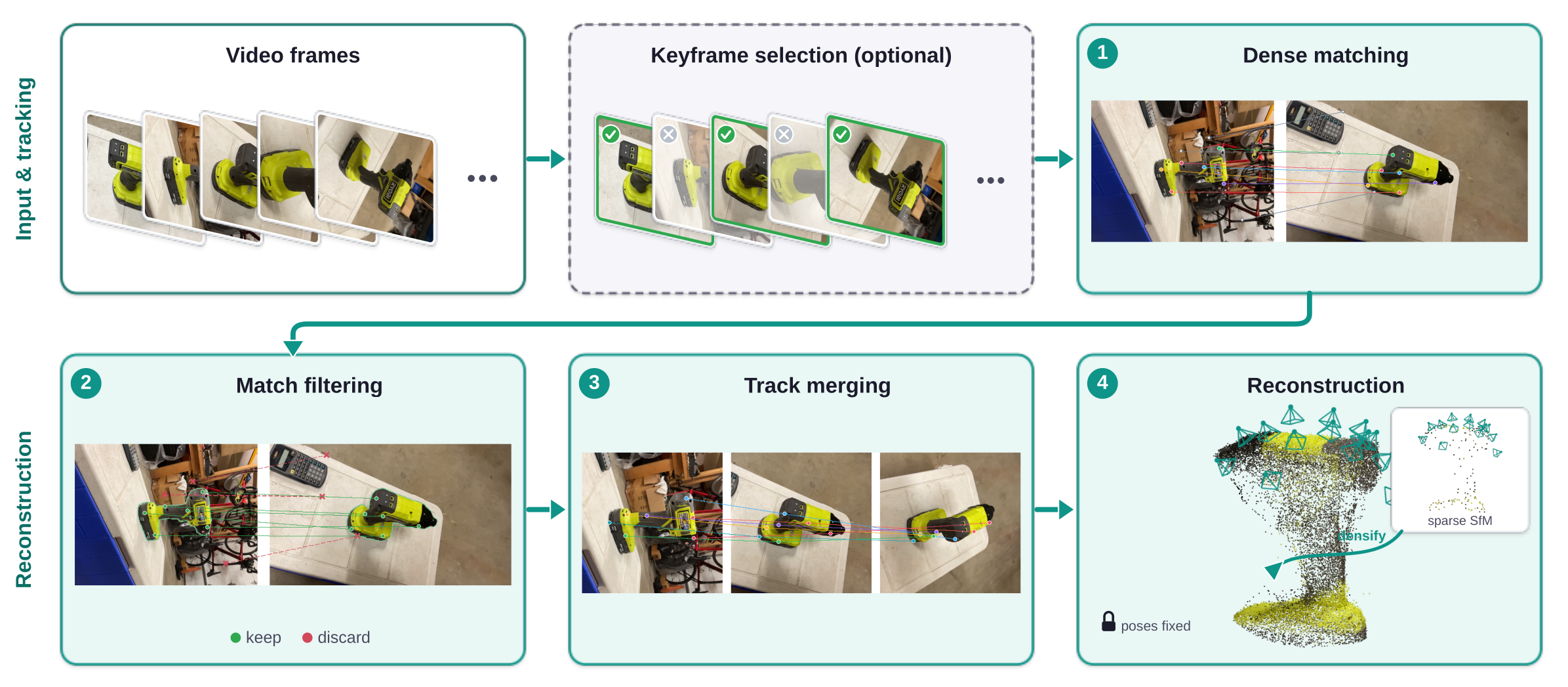
The pipeline runs in four stages.
- Dense matching. SAM2 [2] propagates \(\mathcal{S}_1\) to every frame; the dense matcher UFM [3] then produces dense matches with per-match certainties on the unmasked frames. I add a segmentation input channel and fine-tune the matcher on objects held out from the test set, so that it is forced to produce correct correspondences between the source and target masks, treating that region as a single rigid body while the rest of the scene is free to move. Keyframes are selected online by the share of confident matches.
- Match filtering. A match is kept only when both of its endpoints fall inside the propagated masks, so the reconstructed points belong to the object rather than to the background.
- Track merging. The surviving matches are chained across frames into multi-view feature tracks. This prevents duplicate reconstruction and substantially increases robustness.
- Reconstruction. Incremental structure-from-motion (COLMAP [4]) with intrinsics held fixed recovers the camera poses and a sparse cloud. To obtain a dense cloud \(\mathcal{M}\), the model is densified with frame-wise correspondences at the recovered poses.
The problem looks simple, and its solution is arguably a fairly plain structure-from-motion pipeline, yet it is not solved: on the BOP benchmark [5], model-free object pose estimation (a reference video with some known camera poses, and no CAD model) remains open, unlike the model-based problem where a CAD model is available. The main obstacles to the reconstruction are low-quality matches, correlated matching outliers (a failure mode I met again in the differentiable reconstruction work), and heavy occlusions, where even synthetically injected occlusions after matching degrade the reconstruction sharply.
If I started over, I would move closer to an end-to-end solution in the spirit of NeMO [6]: an encoder that produces the reconstruction alongside a latent representation, and a decoder that detects the object, computes a matching, and directly regresses a pose consistent with that matching.
Links. Manuscript (in preparation, 2026), Jelínek, Mishkin, Matas, available on request. Project page. Code.
References
[1] J. Wang, M. Chen, N. Karaev, et al. VGGT: Visual Geometry Grounded Transformer. CVPR, 2025.
[2] N. Ravi, V. Gabeur, Y.-T. Hu, et al. SAM 2: Segment Anything in Images and Videos. arXiv:2408.00714, 2024.
[3] Y. Zhang, N. Keetha, C. Lyu, et al. UFM: A Simple Path towards Unified Dense Correspondence with Flow. arXiv:2506.09278, 2025.
[4] J. L. Schönberger, J.-M. Frahm. Structure-from-Motion Revisited. CVPR, 2016.
[5] V. N. Nguyen, S. Tyree, A. Guo, et al. BOP Challenge 2024 on Model-Based and Model-Free 6D Object Pose Estimation. arXiv:2504.02812, 2025.
[6] S. Jung, L. Klüpfel, R. Triebel, M. Durner. Finding NeMO: A Geometry-Aware Representation of Template Views for Few-Shot Perception. 3DV, 2026.